The Pre-Raphaelites were a small group of English painters that desired a return to the simple morality of the European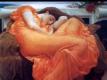 style of paintings that came before the time of Raphael, at the height of the Renaissance. England was enjoying the quiet aftermath of victory after the Battle of Waterloo in 1815 and the industrial revolution was also reaping its economical benefits in the expansive Empire of Great Britain. Despite the great poverty of the general populace, Queen Victoria 's reign was markedly serene and the art of the period reflects this reality. Victorian art is therefore a true mirror of Victorian culture, expressing the gentlemanly refinement, the core moral superiority and self-justification that is the hallmark of the wealthy and the powerful.
In 1848 an artistic pact was made between seven aspiring young artists to express serious themes in their work with candid simplicity and fidelity to nature. They worked together for roughly ten years before going their own way. The artists Dante Gabriel Rossetti, William Morris , John Everett Millais, James Collinson , Edward Burne-Jones, William Holman Hunt and Vulner began working in this style in 1848. They spurned the traditional academic style that was common in England , seeing it as being trivially themed and lacking in any moral or emotional intensity. They wanted to revere nature in their paintings; they took pride in painting in fine attention to detail and used a very pale, bright palette of colors on a pure white background. The early group focused almost entirely on nature scenes or scenes taken from the bible, but later on this group would deteriorate into themes of dreamy-eyed girls posing in elegant compositions of lovely pastels.
